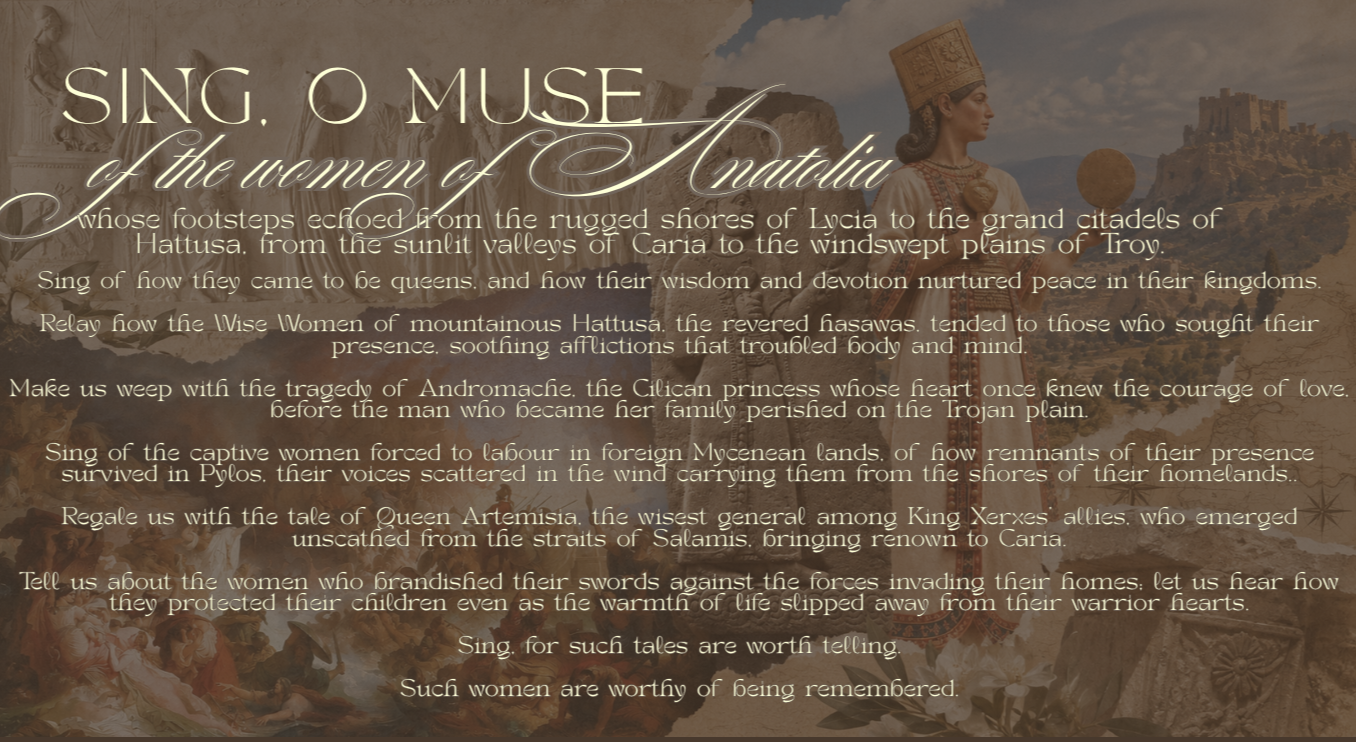
Welcome to Feminanatolia, my special little corner of the internet where I will share essays and creative writing pieces about the women of ancient Anatolia :)
I’m Alara, a prospective archaeology student whose interest in the ancient past began when I first read Jason and the Argonauts for my English class at the age of eleven. I remember I bought Karl Kerenyi’s Greek mythology books that year; not long after that I found out there was a book series called Percy Jackson and the Olympians, and fell in love with the chapters of epic quests, and the unbreakable bonds of family and friendship told from the gripping, humorous, and deeply endearing narration of a modern-day demigod. I even gave what could be called mini-lectures on the myths I read about to a small group of my close friends during the 35-minute afternoon recesses. We would find mythology trivia and “Who is your godly parent?” personality tests, and the best thing was I could see that with every story I shared, the spark of curiosity was becoming ever more perceptible in my friends’ eyes. The memory of the feeling of happiness when your enthuisasm is shared by people who find what you have to say worthy of being appreciated and discussed still brings me a special kind of joy.
So, you can imagine how excited I was when I learned that the author of Percy Jackson, Rick Riordan, had also written book series whose magic systems were immersed in Egyptian and Scandinavian mythologies. As an incorrigible bookworm, I couldn’t help but fly through those books, losing myself in stories inspired by the myths that had once shaped the lives and creations of the people who experienced the beautiful tragedies and idiosyncrasies of life in a faraway time.
Here, it would be relevant to mention that I grew up in İzmir, in Southwestern Turkey, surrounded by the remnants of ancient cities such as Smyrna, Ephesus, Halicarnassus, Pergamon and Troy. All along, I had lived in the heart of the ancient Aegean, just a short walk or a car ride away from the historical sites where some of the most influential and famed accounts of ancient history and literature, such as Homer’s Iliad and Herodotus’ The Histories, had played out. Even though I had visited some of these ancient cities with my family before, it wasn’t until I became interested in the mythologies of the ancient past that I realized I was living in a treasure trove of history, in a place that could whisper marvelous tales of its past, just like the ones in the books I lost myself in, if I were willing to uncover the lives it had witnessed by looking beyond what was on the surface; so that instead of seeing a lone column on the side of an ancient walkway, I saw the Temple of Artemis Ephesia, where libations were made and rites of passage unfolded, where men and women had once sought sanctuary from the cruelties of wicked hearts. When I saw a tarnished coin or a stone inscription under the warm lights of a museum, I imagined the person behind the words, the circumstances and events that led to a piece of them surviving in these millennia-old excerpts of their lives. I held the enticing gaze of a statue and realized how the art we leave behind has the power to stir curiosity and inspiration within the hearts of generations to come, and how there are so many ways to leave a mark upon this world, to let your story be heard by the ones who will one day dare to listen without the stain of prejudice clouding their minds.
As my passion for ancient stories continued to grow throughout the years, I was drawn to retellings of ancient myths from the perspective of women, who had long been the side characters, scapegoats, or cautionary tales in the stories of male heroes’ glory and valor. I read modern retellings such as Madeline Miller’s Circe, Jennifer Saint’s Elektra and Ariadne, Margaret George’s Helen of Troy throughout junior high and high school; I also, finally, read the Iliad and the Odyssey in my sophomore year, as well as classical retellings of Homeric tradition such as The Oresteia and Medea. With Medea, I was able to experience the myth that started my love for ancient history, Jason and the Argonauts, as it drew to a close with tragedy, this time with a woman as the focal point of the play. What really stuck with me was Medea’s awareness of her role in the story, how she recognized her power and called out the oppression and injustice women are subjected to. It quickly became one of my favourite pieces of classical literature.
It was a year later when I found out that Emily Hauser, a classics professor at the University of Exeter, had written a book called Mythica, which examined the lives of real-life Bronze Age women behind the tales of those portrayed in Homeric tradition, such as Troy’s Queen Hecuba, the Amazon Penthesilea, Andromache, and Cassandra. Through this book, which escaped the confines of Hellenocentrism to examine the Late Bronze Age World from a multi-cultural perspective, I learned about the Hittites’—an Anatolian empire which was one of the key players of the Late Bronze Age socipolitical stage— interactions with the neigbouring kingdom of Ahhiyawa, and how their references to a vassal state recorded as Wilusa may hold the key to understanding the birth of the Trojan War saga. Most significantly, I learned how the Hittite queen Puduhepa, once a priestess from the Anatolian region of Kizzuwatna, engaged in diplomacy, as evidenced by her correspondence with the Egyptian royal court and her name indelibly stamped on the Treaty of Kadesh, and became Tawananna, exercising considerable religious and political authority as both Chief Priestess and Queen (Even though I had been taught in the Turkish curriculum and thus already had some knowledge of them, I had never been taught about this influential Queen of the Late Bronze Age—the curriculum is sorely lacking in its coverage of the lives of women regardless of the eras discussed—and suddenly I couldn’t wait to read more about the lives of all Anatolian women, not just those who lived in the Troad region.) I also learned that the Aegean, the sea I had lived by my entire life, might have been named after an Amazon queen from Libya, and about the realities of Anatolian enslaved women in Mycenaean lands. So, this summer—in pursuit of more knowledge—I browsed the internet, searching for essays on the historical realities behind Homer’s depiction of the Trojan War, the Linear B records, the lives of Hittite women and the exchange of deities that occurred between Mesopotamia, Anatolia and Ahhiyawa (Mycenaean Greece), writing essays and story excerpts as I went. Starting on September 26, I will publish two essays every week, bringing the women of ancient Anatolia from the margins of ancient texts to the foreground of my discussions, sharing archaeological discoveries that shine a light on their lives, as well as analyzing their experiences in the wider context of the interconnected world they lived in. If you’re interested in learning about the unsung tales of ancient Anatolian women, you’ve come to the right place!