The Legacy of Anatolian Women in Mycenaean Greece: From The Shores of Anatolia to Pylos
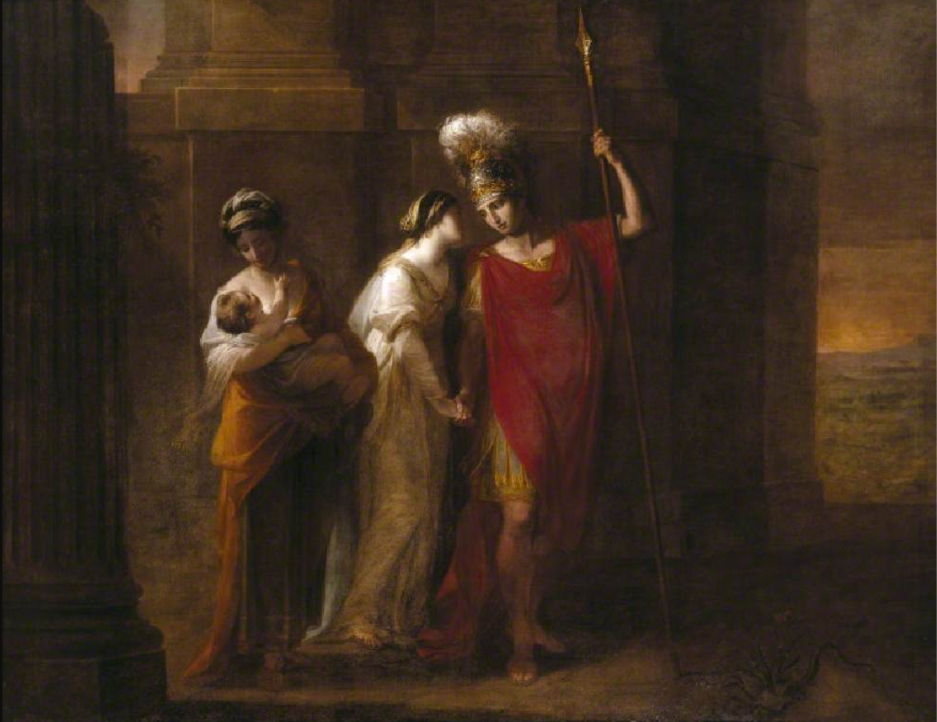
In the sixth book of the Iliad, Hector visits Andromache in Troy. This is his very last encounter with his wife and son, before he is brutally killed by Achilles in an act of revenge for the death of his dearest companion, Patroclus. Leaving the blood-stained plains of honor, Hector searches for her in places where one would expect to find a woman: cloistered with her enslaved women at home, engaging in the women’s supplication at the temple with Queen Hecuba, or visiting her sisters-in-law. However, he fails in his search for her in the women’s sphere. Instead, he’s told that she has taken their infant son and run up on to the walls of Troy to see the world of men, in a desperate attempt to find out the state of the Trojan army on the battlefield below. In her book Mythica, classical scholar Emily Hauser makes the observation that war is turning their marriage upside down: “Hector, the general, is knocking at his own door behind the city walls, while his wife surveys the troops from the battlements. Husband and wife are trying, desperately, to engage with each other’s divided worlds.” Catching sight of Hector at the Scaean Gates, about to leave for battle, Andromache hurries down to meet him, not knowing, although perhaps sensing, that this is the last time she’ll see her husband, the only family she has left, alive. Once a princess of the Cilician Thebes, a town in Troy’s vicinity which Achilles and the Greeks sacked in the early years of the Trojan War, she has already lost her father and seven brothers at the hands of Achilles; her mother was enslaved by him before being freed for ransom (Homer 1950, 6.414-28). So when she says to her husband “Hector, you are my father and my mother. You are my brother, and the vigorous man whose bed I share.”, she is trying to put into words the deep, vital bond they share, and pleading with him to understand that she could not bear losing him too.
Andromache even predicts that if he does not follow a more defensive strategy, and fights on the frontline, he’ll die. But, as Hector meets her plaintive gaze, he knows that he cannot give her the answer she seeks. He has to be on the frontline, leading his troops, avenging the deaths of his brothers and soldiers, and winning glory for the House of Priam. As a Homeric man and the heir to the throne, that is the role he has been allotted, and his obligations to his men and people weigh heavier than his obligations to his wife, even if, in his heart, that is not what he might have wanted as his destiny. Even when he knows that Troy will fall.
Both Andromache and Hector are aware of what the destruction of Troy would mean, and her husband conjures up an image of her future: dragged away by a bronze-clad Greek warrior, she will be shipped to Greece as a slave and forced to do back-breaking labour at her mistress’ bidding (Homer 1950, 6.454-8). He does not mention that she will also certainly be raped by her master, and will have to endure the pain of losing her son at the hands of the Greeks. This was the brutal reality of women whose towns and cities fell, whose homes and lives were razed to the ground, in the Late Bronze Age. And the evidence regarding what might have happened to women like Andromache points us to the archive rooms at the palace in Pylos, home of the legendary King Nestor, the aged advisor to Agammemnon in Homer’s Iliad.
In 1939, American archaeologist Carl Blegen, working alongside Greek archaeologist Konstantinos Kourontinos, unearthed more than 600 clay tablets belonging to a period in time around 1200 BCE–when Mycenaean palaces all over Greece collapsed as the mysterious last acts of the Late Bronze Age played out–at the Palace of Nestor. The tablets were inscribed with minute symbols in a language no one recognized. This language would later come to be known as Linear B, and would be deciphered thanks to the efforts of Alice Kober–a Classics Professor at Brooklyn College in the 1940s, who figured out that the mysterious language had gendered words but passed away before she could finish the job–and Michael Ventris, a young architect and amateur enthusiast who, building on Kober’s work, revealed the Linear B language to be an “inflected” one, meaning the language has word endings that vary according to the words’ gender and role in the sentence. Thus, it was established that Linear B was an early form of Greek and that the Mycenaeans of the Late Bronze Age spoke a version of Greek, ultimately proving Homer right on this point.
The most important finds for our purpose of uncovering a glimpse into the life of Anatolian women–just like Andromache and the surviving women of Troy–who were taken to Greece as slaves, lie in the bureaucratic lists found in the archive rooms of the palace in Pylos. These lists are evidence of the vast network of industries the palace administration supported, including textile production, the manufacture of luxury perfumes, livestock management and food processing. In addition to these, they hold the names of suppliers and receivers of goods (Hauser 2025, 57). Which means that the rations the palace administration supplied to its foreign slaves, who worked in the aforementioned industries, have also been recorded. Specifically, the Aa and Ab series of tablets have been classified by archaeologists as detailing information regarding women’s labour force (Ventis and Chadwick 1956, 155). Tablet PY Ab 194 has inscribed upon it these words: “At Pylos, 7 Chian women who make o-nu-ka, 3 girls, 6 boys, 288 litres wheat, 288 litres figs, 1 DA 1 TA” (Hauser, 58) In this record, we are introduced to 7 women from Chios, a mountainous island in the eastern Aegean, which sat at the heart of a cultural and commercial crossroad that put it in contact with Troy to the north and the Cycladic islands to the west, as well as with the Mycenaeans of Greece. The Chian women’s occupational title is “women who make o-nu-ka” (Koropeckyj 2019, 3). This is a finely ornamented cloth border, which means that these women, possibly brought from Anatolia as slaves, were highly specialized textile workers working in the heart of the Palace at Pylos. In addition, they are accompanied by their children: three girls (ko-wa in the original Linear B script, which –as Kober successfully guessed–was a feminine-gendered word) and six boys (ko-wo) who also get a share of the food provided by the palace administration, which is listed as “288 litres wheat, 288 litres figs”. Finally, “TA” has been identified as a supervisor for the group, while “DA” signifies a higher ranked supervisor. In her book, Women in Mycenaean Greece, historian Barbara Olsen states that both supervisors were likely women. Although it appears that these women got to keep their sons and daughters with them, unlike Andromache, whose infant son was killed, and Hecuba–who was separated from her daughters and shipped to Ithaca as a slave in the household of Odysseus, and whose sons perished on the battlefield, two of them ambushed and murdered by Troy’s enemies off the battlefield to add to her tragedy–they are nonetheless representative of what enslaved Eastern Aegean/Anatolian women in Mycenaean Greece would have experienced in the Late Bronze Age.
Chios isn’t the only place listed from which foreign, East Aegean/Anatolian, slaves were taken in the Linear B tablets. Of the 10 ethnic titles used, 7 of these have been identified with locations in the East Aegean/Anatolian: Assuwa/Lydia (modern day Antalya), Knidos (modern day Burgaz, Datça), Chios, Miletus (modern day Didim), Lemnos, Zephyros (Halikarnassos, or modern day Bodrum) and even Troy (modern day Hisarlık, listed as to-ro-ja, or Troia in the Linear B record). All of these women were assigned to low-status, labour-intensive and back-breakingly repetitive tasks such as wool-carding, flour-grinding and linen-working (Olsen 2014, 28-29, 109, 111-113). Their eastern-Aegean ethnicity, as well as the lack of any individual identity in the lists that could be used to distinguish them from one another–specifically the non-existent record of their names–characterize their surviving presence in the Mycenaean socioeconomic spectrum. Conversely, other, presumably higher-status, women’s names are recorded on the Linear B tablets: Karpathia, Philopatra and Kessandra are three of the names found attached to women in the Mycenaean record, to name a few (Olsen 2014, 40-41). According to scholars Kalliope Efkleidou and Barbara A. Olsen, the Anatolian women who were captured on the east Aegean coast by the Mycenaean Greeks, and forced to work for their economy as enslaved women, were separated from the men (the aforementioned tasks were for women only) while their children were co-opted for labour, with boys being taken away from their mothers to labour in the fields as soon as they reached maturity. The women and their children were dependent on the palace for their survival, through the food rations apportioned to them.
There is one last piece of evidence found in the bureaucratic lists in the Palace of Nestor for the reality of enslaved Anatolian women in Pylos, one which we can trace back to the Iliad itself. At one point in the tablets, these women are listed alongside a cluster of Linear B symbols that gives us a single word: ra-wi-ja-ja (or lawiaiai). This word seems very likely to be the Linear B version of the same term which Achilles uses in the Iliad to boast about his capture of Briseis and the women of Lyrnessus (one of the towns surrounding Troy, similar to Andromache’s Cilician Thebes) : lēiades, meaning captive women slaves (Chadwick 1988, 83, 91-92). Achilles’ exact words in regard to Lyrnessus are: “I ravaged it, and took away the women as captive slaves, robbing them of their day of freedom.” Considering that this is the Homeric hero with possibly the greatest fame, the one even modern audiences who haven’t read the original material would recognize by name as the “greatest warrior in mythology” thanks to his popular portrayal by Brad Pitt in 2004’s “Troy,” in which his relationship with Briseis is presented as consensual and romantic, rather than an instance of a plunderer raping a victim, with the mentality that owning her body is his right because she is his prize and a proof of his prowess in battle—it is apparent why so many modern female authors–Emily Hauser and Pat Barker immediately come to mind–feel the need to tell the story of the Trojan War from the women’s point of view, to shift the focus from men, men’s power and honour, to the women who endured the horrible price of war, who suffered, loved and fought; women whose experiences are just as worthy of being remembered and revered as those of men.
In the end, it is up to those of us who find meaning in uncovering women’s version of history, in bringing to the surface the lives that went largely unsung in the ancient stories and records humankind has passed down through generations, to search for both the extraordinary and ordinary experiences that made her who she was. Whether we find fragments of her in a bureaucratic record hastily written down by a palace scribe, in a beloved epic that depicts both the beautiful and ugly aspects of humanity all at once, in personal letters and literature written by her own hand, or in any other way that she left a mark upon the world–even one indicating as simple a message as “I lived”--she will always be worth searching for.
Written by Alara Ural
Bibliography
Hauser, Emily. Mythica. Doubleday, 2025.
Olsen, Barbara Ann. Women in Mycenaean Greece: The Linear B tablets from Pylos and Knossos Routledge, 2014.
Chadwick, John. "The Women of Pylos." In Texts, Tablets and Scribes Studies in Mycenaean Epigraphy and Economy Offered to Emmett L. Bennett. Ediciones Universidad de Salamanca, 1988.
Homer. The Iliad. Translated by E.V. Rieu. Penguin Books, 1950.
Koropeckyj, Damian. Anatolian Women in the Lineae B Texts. 2019.
Ventris, Michael, and John Chadwick. Documemts in Mycenaean Greek: Three Hundred Selected Tablets from Knossos, Pylos, and Mycenae with Commentary and Vocabulary. Cambridge: Cambridge University Press, 1959.
Efkleidou, Kalliope. "The Status of "Outsiders" within Mycanaean Pylos." 2003.
Angelica Kauffman’s 1768 painting Hector Taking Leave of Andromache
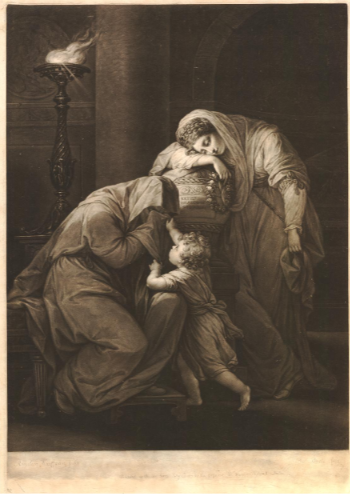
Andromache Weeping Over The Ashes of Hector by Angelica Kauffman
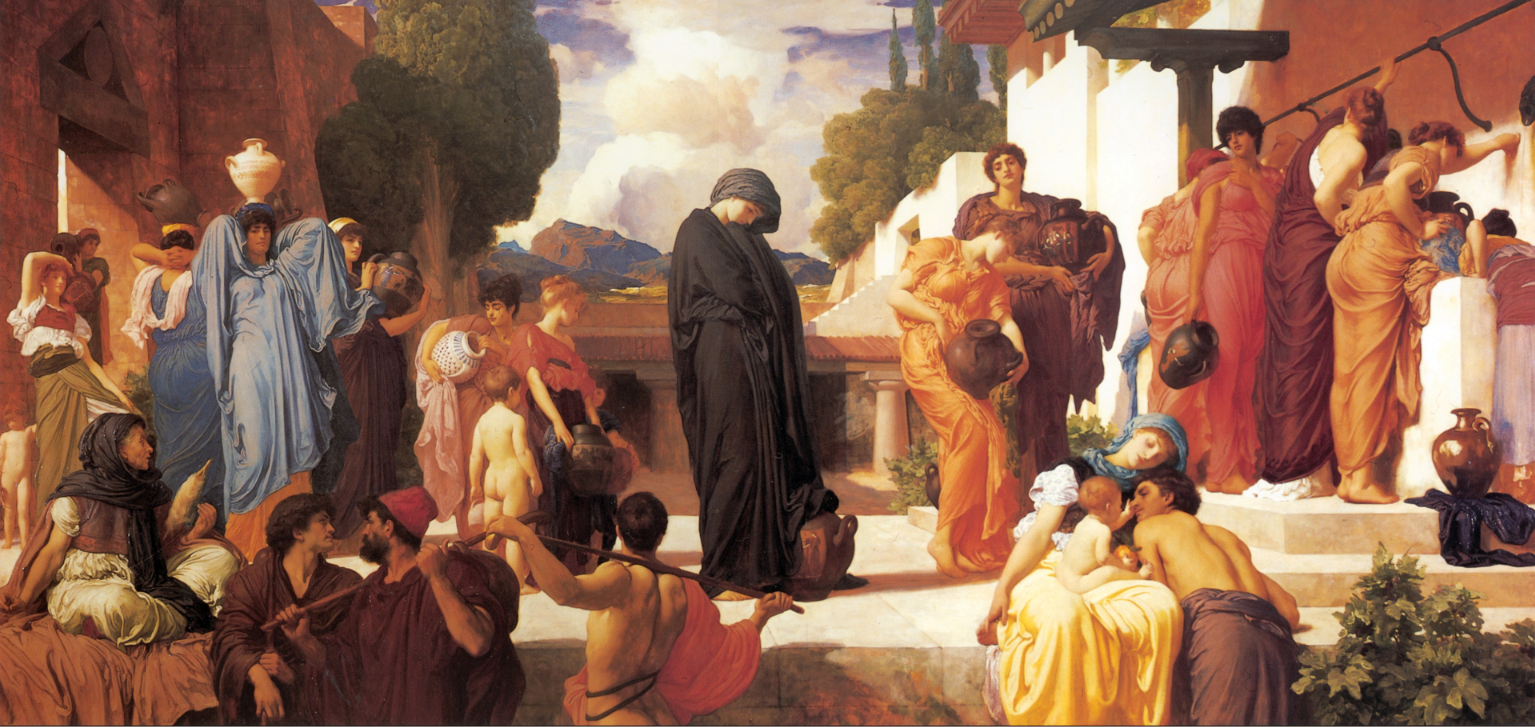
Frederic Leighton’s painting Captive Andromache, from c. 1886-1888