“
Abstract
In one of her prayers to the Sun Goddess of Arinna, the Hittite queen Puduhepa describes herself as the goddess' "long-time servant, calf of [her] stable, stone of [her] foundation." More than three thousand years later, those words invite an intriguing question, one that has gained renewed significance as archaeologists and classicists have begun to analyze the Homeric tradition beyond Hellenocentrism: could one of the most influential queens of the Late Bronze Age have been a stone in the foundation of Homer’s portrayal of Hecuba?
Bringing together Hittite royal inscriptions, diplomatic correspondence, Linear B evidence, Homeric epic, and archaeological discoveries concerning Wilusa (Troy), this study re-examines the Queen of Troy from an Anatolian perspective. It investigates the historical connections between the Hittite Empire, Wilusa, and the world remembered in the Iliad, while comparing Hittite queenship with Mycenaean conceptions of female political and religious authority. Through this interdisciplinary approach, it explores whether Hecuba's characterization preserves reminiscences of the political and religious realities embodied by Puduhepa and her predecessors. Rather than seeking to identify Puduhepa as a direct historical prototype for Hecuba, my aim is to consider how cultural interaction, oral tradition, and historical memory may have carried elements of Late Bronze Age Anatolia into the Greek epic tradition, and contribute to the growing body of scholarship reconsidering the Homeric tradition beyond a solely Hellenocentric framework.
Introduction
We set the scene in the late 13th century BCE. The Hittite Empire–a vast central Anatolian power ruled by the Great King Hattusili III and the Great Queen Puduhepa–is one of the key imperial players in the ancient Mediterranean and Southwest Asia, controlling territory from the Aegean coast near Wilusa (Troy) in the west across modern day Turkey and into Syria. At the border of the western edge of the Hittite heartland lies the region later known as Phrygia–the kingdom where, according to Homer, Queen Hecuba of Troy hails from (Homer, Iliad 16.715). Once a princess, watching from the battlements as merchants from around the ancient world–from Mesopotamia to Mycenae–filled the trading routes of her homeland with the scent of fresh dates, grapes and the rustle of papyrus–she would become the wife of Priam, leaving her homeland to assume the throne as the Queen of Ilios on the north-western Anatolian coast. Her image and name would endure through the tale of the stoic queen who lost her sons and daughters–her pride and joy–at the hands of the ruthless Achaeans, embellishing the songs of bards across Greece throughout the Dark Ages following the Late Bronze Age collapse (c. 1200-1100 BCE), when major civilizations—such as the Mycenaeans, Hittites, and Egyptians—suffered a near-simultaneous collapse, severe economic disruption, and loss of writing.
Yet, before Hecuba was immortalized in Homer's Iliad about 450 years after the collapse of the Hittite Empire and the ruin of Troy VIIA—which archaeologist Carl Blegen identified as the layer most likely to correspond to the city remembered in the Trojan War tradition—a young priestess from Kizzuwatna in south-east Anatolia would meet the Hittite prince Hattusili III as he passed through the region on his way back from the Battle of Qadesh, the fateful encounter sealing her fate as the future Tawananna (Chief Priestess and Queen) of the Hatti people (Hauser 99).
Leaving her homeland behind, just like Hecuba, Puduhepa would arrive at the palace at Hattusa, whose sprawling , many-chambered halls bustled with princes and princesses born to Hattusili's second-rank wives and concubines. Although it would take the death of Hattusili's brother, King Muwatalli II, and, later, Hattusili's successful coup against his nephew Mursili III before the couple ascended the throne, Puduhepa would not only rule the empire alongside her husband; she would also step into the role of nurturer for the royal children, raising both her own offspring and those she found at the palace. She even recalls delivering the babies of her step-daughters in a message to Pharaoh Ramesses II, preserved on one of the clay tablets uncovered at Boğazkale between 1906 and 1912 (Taggar-Cohen).
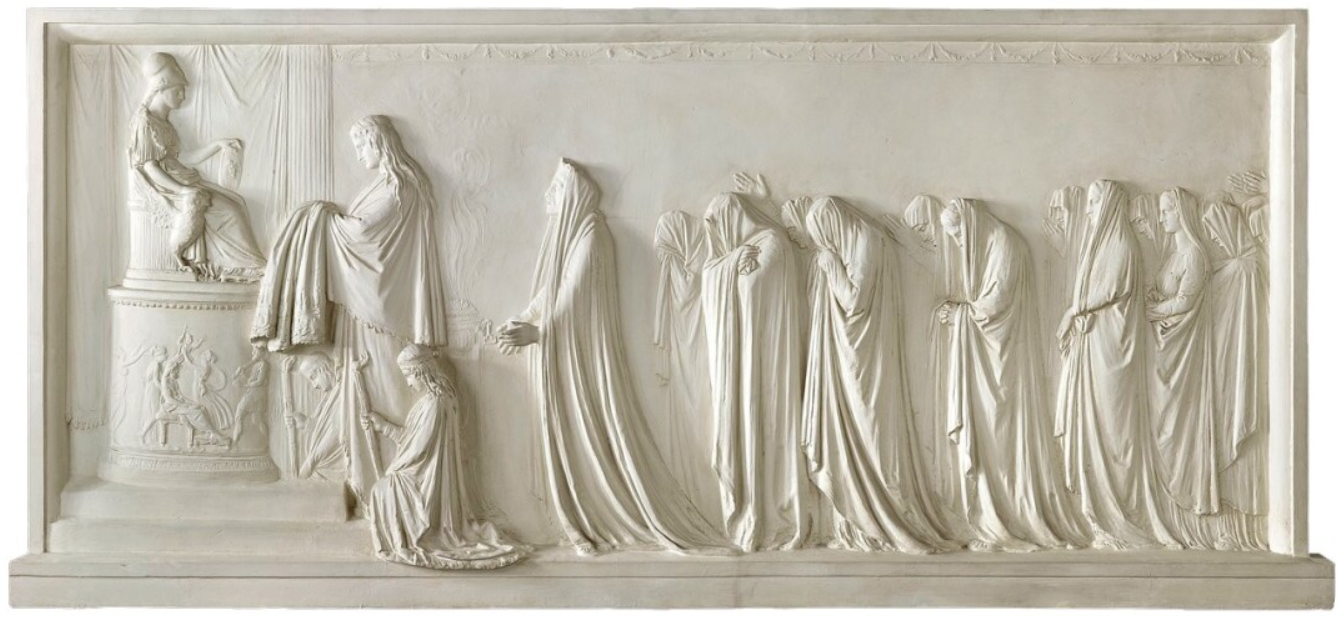
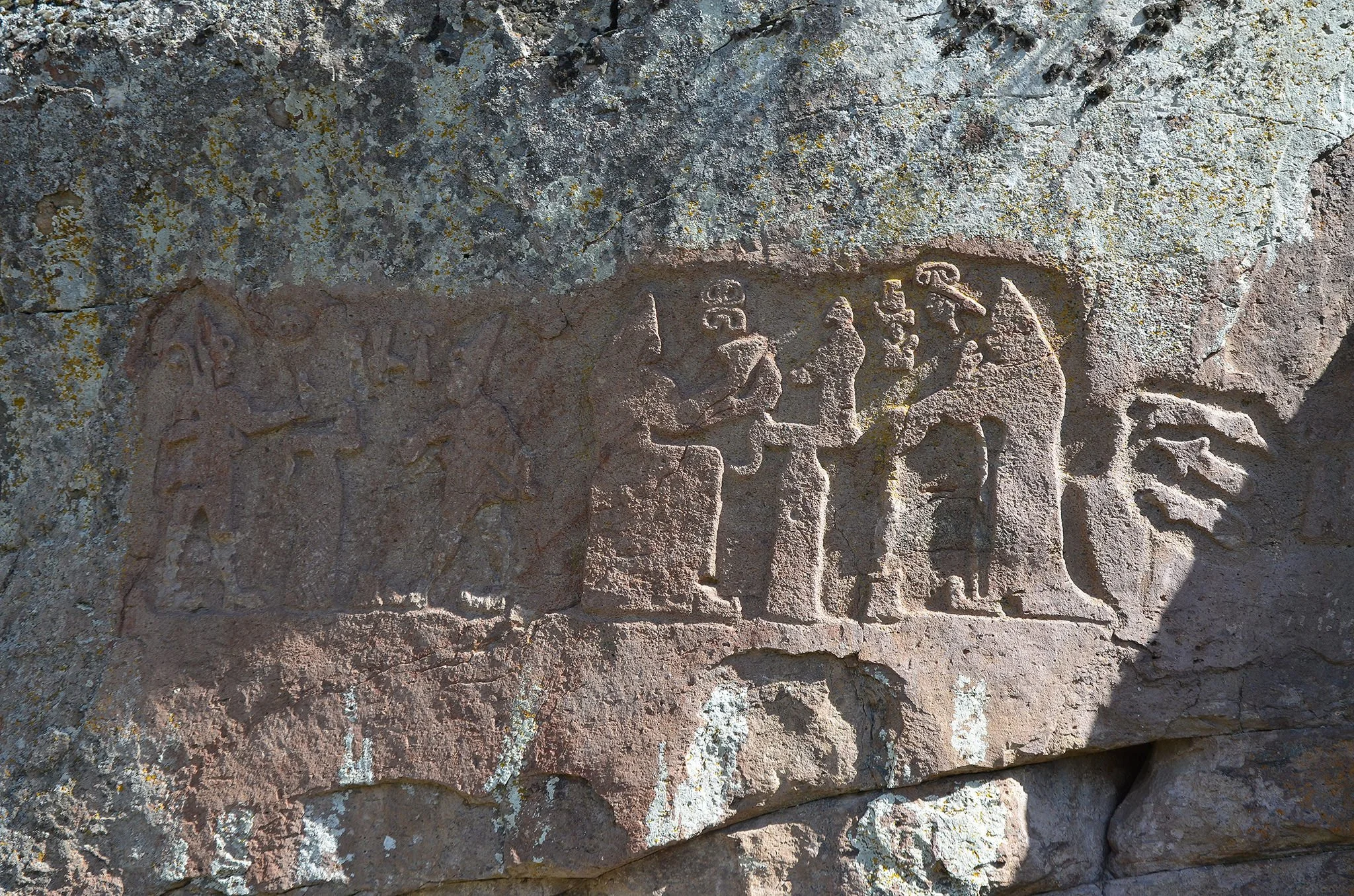
Similarly to Puduhepa’s situation, Hecuba enters a royal household where Priam’s children from previous wives and concubines are already present. Both Puduhepa and Hecuba nevertheless succeed in earning high esteem among their people. Hecuba does so by bearing legitimate heirs to Priam and upholding the spiritual dignity of her people–epitomized by the scene where she and a procession of elder women and attendants chosen by her, along with the priestess Theano, offer a ceremonial peplos to Athena, making a supplication to the goddess to end the bloodshed caused by the Achaean warrior Diomedes. Puduhepa, in contrast, earns such esteem by serving as both an effective diplomat and Chief Priestess, as demonstrated by her royal seal appearing alongside her husband’s on important political documents such as the Treaty of Qadesh–the earliest known peace treaty in world history–between the Hittite and Egyptian empires, and by her supplication to the sun goddess Hebat to vanquish their enemy, the warlord Piyaramadu, indelibly written into the record on clay tablets in Hattusa (Hauser 99-101).
Although Puduhepa belongs to the historical record and Hecuba to the epic tradition, the remembrance of their shared experiences help us understand the social and political landscape of the Late Bronze Age from the perspective of a real life Anatolian queen. Analyzing the differences between Achaean norms for royal women and their Hittite counterparts, this essay argues that the Iliad preserves cultural memories of the institution of Hittite queenship through the character of Hecuba. Rather than suggesting that Homer consciously remembered Puduhepa herself, I contend that the oral traditions underlying the poem retained echoes of the political and religious authority exercised by Hittite queens during the Late Bronze Age.
Two Visions of Queenship
The duty of a queen in regard to her political and religious authority differed remarkably between the Achaeans (otherwise known as Myceneans) and the Hittites. In fact, looking at the historical record from the Linear B tablets found in Pylos–which contain an early form of Greek spoken before the Bronze Age collapse–there is no analogous equivalent for the word “queen,” while the highest position for a man in Mycenaean society is documented to be “wa-na-ka,” which is Homer’s (w)anax, ‘king’ or ‘lord’, a title given in the Iliad to Agammemnon. In contrast, his queen Clytemnestra is only referred to as kouridiē alokhos, meaning lawfully wedded wife. Mirroring the archaeological evidence from the Linear B tablets, Hecuba isn’t given the title of “queen” in the epic; instead, her power and identity are defined by her relationship to the city’s ruling men (she is called Alokhos Priamoi–Priam’s wife– and Mētēr Hektoros, Hector’s mother), in accordance with the Achaean notion of a royal wife. Furthermore, when we consider the names and titles preserved in the Linear B tablets of those recorded as suppliers and receivers of goods, we find that none of the ruling elite documented there are women, and no women ever holds a secular office in the Mycenaean palace administration (Shelmerdine 618-32). This contrasts sharply with how Hittite queens–such as Puduhepa and one of her predecessors, Ḫarapšili–held the titles of both haššušara(corresponding to the title of ‘queen’) and Tawananna, allowing them to gain near-equal status with the king, act as the Chief Priestess of the realm, and retain independent authority for life, often ruling as co-regent with their son after the king died. For example, according to Hittite diplomatic texts dating to around 1220 and 1210 BCE, Puduhepa continued to wield considerable political and economic influence throughout her son Tudhaliya IV’s reign, allocating the budget for her religious cult and providing assistance to the king in judicial matters (Taggar-Cohen).
Considering Homer’s portrayal of Hecuba as a powerful queen figure with a favourable, and political, access to the divine, exemplified by the scene in which she leads the sacrificial procession to the temple of Athena, the argument that remembrances of Hittite queenship were preserved in the Queen of Troy–who, after all, is supposed to be an Anatolian queen, given that the Trojans were an Anatolian people, not part of a Greek colony like Miletus–becomes stronger as the analysis of Homeric tradition by looking beyond Hellenocentrism opens room for further discussion on the cultural interactions between the Bronze Age Anatolians and Mycenaeans.
To extend our thinking beyond Hellenocentrism when analyzing the characterization of Hecuba, we first have to acknowledge that women could hold power in Late Bronze Age Greece, although it was outside the political realm of queenship and in the sphere of sacred priestesshood, especially through the responsibility of conducting rituals. Mycenaean priestesses could attain high status within their respective gods’ and goddesses' cults (as in the case of Theano, priestess of Athena in the Iliad), and were even, on occasion, granted leases of land as a special mark of distinguishment (Hauser 105). One historical example of a priestess who, apparently, held high status in her community is that of priestess Eritha at Pylos, who, as the Linear B tablets (deciphered by Alice Kober and Michael Ventris) show, leased both private and public land (Shelmerdine 619-20). Thus, it is apparent that, despite having the opportunity to rise in status through religious authority, Mycanean women–even those married to kings–could not wield significant political power alongside a priestly role in any way resembling their Hittite counterparts. Then, could it be that through his portrayal of Hecuba, Homer was trying to make sense of the roles occupied by a Late Bronze Age Anatolian queen for an Iron Age Greek audience?
The Fate of Wilusa: Puduhepa and Hecuba in War
To answer this question, and see if there’s a point of convergence between the Homeric account regarding the Mycenaeans, Trojans and Hecuba, and the Hittite record concerning Puduhepa, the Hittites, and the kingdom of Wilusa, we must direct our attention back to the Hittite archives. There, in a votive prayer, written on a clay tablet uncovered among a treasure trove of texts (personal letters, diplomatic agreements, collections of laws and prayers) excavated at Hattusa, and dating to the thirteenth century BCE, we find Puduhepa supplicating the gods as the Chief Priestess of her empire; promising sacrifices of an ox , eight-sheep, and gold, if her supplication is answered favourably (Morris, 159). In this supplication, she invokes Hebat (a goddess from her homeland, Kizzuwatna, whom Puduhepa introduced into the Hittite pantheon, merging her with the Hittite sun-goddess Arinna), asking for the salvation of her husband’s kingdom and the destruction of Piyaramadu, who–according to Hittite diplomatic texts exchanged between King Hattusili III and the Ahhiyawan king–was a rebel warlord causing trouble on Hittite trade routes, attacking the empire’s borders and disrupting the peace in the north-west Anatolian city called Wilusa, or Wilios (Beckman, Bryce, and Cline 101-22) . This is where we find a linguistic echo of the geography of Puduhepa’s world in the Iliad, since, in Homer’s epics, the city of Troy has two names that are used interchangeably: Troy (Troie) and Ilios, the root of the epic’s Greek name Iliad–a word that, in Homeric Greek, would actually have been pronounced as Wilios before the Greeks stopped using the “W” sound in their spoken dialects, and the name became Ilios (Scully, 7-8).
Moreover, the historical city of Wilusa mentioned in Hittite diplomatic documents occasionally crops up next to another name–Tariusa–that seems to have been used for the region nearby (Bryce, 692-3). The geographical and linguistic match between the northwest Anatolian city of Wilusa/Ilios–the city–and Taruisa/Troy–the region–is so remarkably close that most scholars of the 20th and 21st centuries–most notably the Swiss linguist Emil Forrer and German classicist Joachim Latacz–agree that Wilusa was the city that Homer remembers as Ilios–or Troy. But how was the Hittite empire and–by extension–Puduhepa, connected to Wilusa? And why would her husband and the king of Ahhiyawa–who historians and archaeologists believe to have ruled Mycenaean Greece, as it is now widely agreed that the term ‘Ahhiyawa’ is a Hittite version of the ancient Greek Achaia, the land of the Achaioi, or ‘Achaeans’--be at odds about the warlord Piyaramadu launching attacks on this city?
The answer lies in the geopolitical importance of Wilusa/Ilios in regard to its key position in the Aegean trade network, and the threat the rebel Piyaramadu–who was protected by Ahhiyawa, or the Mycenaean Greeks–posed to the political influence the Hittite Empire had over the north-west shores of Anatolia, as we know from Hittite records that Wilusa– ruled by King Alaksandu–was allied with the Hittites. The name of the Wilusan king–Alaksandu–is notably similar to that of Hecuba’s son, Prince Alexandros, better known as Paris, in the Iliad (it seems likely that Paris is probably a local Anatolian name added to the epics to give a bit of foreign flavour, while Alaksandu was an alternative that could seamlessly be assimilated into the Greek Alexandros for the poems’ audience) (Kanavou 83-6; Watkins 56-8). It is also worth mentioning that among the names of the allies who were said to have supported the Trojans on the battlefield after Hector’s death, Homer presents us with “the Keteioi”--a name that has been interpreted as a Hellenized reference to the Hittites, as it echoes the term that they used to refer to themselves, the Hatti (Hauser, 102), as well as the Egyptian name for them, the Khetti. Moreover, the letter Hattusili III sent to the Ahhiyawan Great King reveals that he and his brother were acting in concert in aiding the Luwian warlord Piyaramadu, providing him protection by allowing him to use Ahhiyawan-controlled territories, such as the city of Milawanda (classical Miletus), as a safe haven against the Hittite demands for his surrender.
The similarity of the events recorded in Hittite diplomatic records to the Homeric narrative of the Trojan War, particularly to the Achaean/Mycenaean attacks from Piyaramadu-like warlords such as Diomedes and Achilles at the city of Ilios, brings us back to the dire situation both the Trojans and the Hittites were in that called for divine aid. In the historical record, as well as the Homeric epic, this divine aid was interceded for by the queens, Puduhepa and Hecuba, the former leading a group of priestly attendants, royal officials, scribes and sacrificial personnel in a prayer to the Anatolian sun-goddess Hebat as the Chief Priestess of her realm; the latter leading a procession of selected Trojan elder women–perhaps a literary trace of ‘Old Women’ female ritual practitioners from Hittite texts– and attendants to the pro-Greek goddess of warfare Athena’s temple, aided in the execution of the sacred rites by the priestess Theano. In an echo of how Puduhepa had supplicated Hebat for the salvation of the Hittite Empire and the destruction of their enemy, promising sacrifices of animals and gold, Hecuba too contributes to the war effort at the plea of her son Hector when she marches up to the temple of Athena. Athena—the Greek goddess whose favour was bestowed upon warriors such as Odysseus and Diomedes, whose aim it was to avenge Prince Paris's insult in choosing Aphrodite over her as the most beautiful goddess (thereby rejecting her gifts of land and glory), and the patron deity of the city of Athens—is, to be concise, a Greek deity to whom the Trojan women's supplications would not matter. Yet it is within her sanctuary that the priestess Theano, on the queen's orders, spreads the ceremonial peplos upon the goddess' knees and promises twelve young cows if Athena shatters Diomedes' spear (6.286-311). In this scene, aware of the conventions within Greek society that would not allow women to hold both political and priestly authority, Homer assigns the prayer itself to Theano, while Hecuba leads the royal procession and directs the ritual. This division of ritual responsibilities separates the royal and priestly functions embodied by an Anatolian queen like Puduhepa, providing a socially acceptable portrait of the supplication to a Greek deity for his Greek audience (Morris 156).
However, when we search beneath Homer’s hellenization of what might be the remembrances of Anatolian culture, we find that the name “Hecuba” may be etymologically linked to a Kizzuwatnan goddess Kubaba (Kizzuwatna was a kingdom in south-east Anatolia, where Queen Puduhepa hailed from) (Oreshko 152). In a similar vein, the Hittite Queen’s name, pronounced Pudu-heba, includes a reference to another Kizzuwatnan deity, Hebat–the sun goddess to whom she prayed for help against Piyaramadu (in Hecuba’s case, Diomedes–although Piyaramadu was ethnically Luwian while Diomedes is Greek). To further underscore the parallels between Hecuba and Puduhepa, and analyze the Anatolian echoes within the Homeric narrative, we need only take note of the epithet given to the priestess Theano in the scene of supplication to Athena, Kisseis (Homer 6.299). In the 12th century, in his Commentary on the Iliad, Eustathius of Thessalonica defined the epithet as a patronymic, and until the 20th century, it has always been taken to mean ‘the daughter of Kisseus’. However, since scholars began to analyze the Homeric texts to find Late Bronze Age Anatolian traces, the epithet has been reread as ‘Kissewan, from Kizzuwatna’. One such scholar is Mary R. Bachvarova, who argues that the “Thracian” genealogy assigned to Theano by Homer was a later archaic Greek re-interpretation of names the Iron Age Greeks no longer understood or recognized from their era’s Anatolian landscape. Since Kizzuwatna, annexed by the Hittites in the Late Empire period, lost its identity as a distinct administrative region when the central imperial system fell around 1200-1190 BCE (during the Bronze Age Collapse), the Greek and Roman poets from later periods could not have recognized the connection between Theano’s name and this south east Anatolian province when penning their interpretations. If the epithet truly derives from Kizzuwatna, it may represent the survival of a geographical memory from the Late Bronze Age that had long since disappeared from the historical consciousness of the classical world. Considering that Kizzuwatna was home to distinctive cult traditions–chiefly worship dedicated to Hurrian, Anatolian and Mesopotamian deities–it wouldn’t be implausible to assume that the etymological root of Theano’s epithet would mean that she was knowledgeable about special cult practices native to south-east Anatolia, the ones observed by Queen Puduhepa (Morris 156). Moreover, among the epithets given to Puduhepa on her royal seal–found by Hettie Goldman in 1934 at Gözlükule–is the phrase “daughter of the land of Kizzuwatna,” providing us with a historical parallel to Theano’s “Kissewan, from Kizzuwatna”. The full inscription around Puduhepa’s royal seal reads ‘Queen of the Land of Hatti, Daughter of the Land of Kizzuwatna, Beloved of Hebat,” proclaiming her status and bringing together her royal, ethnic and religious associations in an indelible mark, her authority felt from the court of Hattusa to the records of the Treaty of Kadesh in Egypt.
Thus, although Homer doesn’t give us a portrait of a politically autonomous queen in Hecuba, we find echoes of Puduhepa and, along with her, Late Bronze Age Anatolian realities in the queen of Troy and the priestess of Athena.
Looking Beyond Homer: An Anatolian Perspective
Even though we can find traces of Anatolian identity in the characters of Hecuba and Theano, the Iliad is, ultimately, an epic that has its roots in Greek. The Trojan women’s supplication, the scene that is most representative of Hittite religious cult practices, is not in the Hittite-related Luwian language the Trojans would probably have spoken, but in Homeric Greek. In the Homeric narrative, neither is the Trojan pantheon different from the Greek one, with Anatolian deities such as Hebat, Ishtar and Teshub being exchanged for Apollo, Aphrodite and Zeus. Yet, when we step out of the Hellenocentric haze that has surrounded the study of the Homeric texts for two millenia, and let an Anatolian perspective, bolstered by archaeological evidence, illuminate these well-known characters once more, we’ll find that there is always another side to the tales that survive.
One tantalizing example of an Anatolian perspective surviving alongside the Homeric tradition lies within two scattered lines preserved in the Hittite archives. The inscriptions read: ‘[And they sing: when they came from steep [Wilusa],’ and ‘when the man came from steep [Wilusa]’. In 1984, drawing on the evidence these brief lines presented, linguist and philologist Calvert Watkins speculated that there might have been a Hittite or Luwian version of the Trojan War. He pointed out that in both the Iliad and Hittite poetic records, Wilusa/Ilios was given the same epithet: steep. In fact, the phrase “steep Ilios” is featured six times in the Iliad, strengthening the theory that through cultural interaction with Anatolian poets, the Mycanean Greeks encountered an earlier version of the Iliad, perhaps a Wilusiad, and appropriated the Anatolian original into their own poetic tradition. Although this hypothesis is tempting, none of the speculations have been confirmed yet, as so little archaeological evidence has been uncovered that would make the Wilusiad a complete, or even unfinished, epic in a way that is similar to the Iliad in regard to its length.
Nonetheless, the prospect of more fragments of a Wilusiad being found in the future brings forth an important chain of questions within the context of this essay: How might Hecuba have been portrayed through the eyes of the Hittites, who knew Puduhepa and thus, were familiar with queens in positions of political and religious power? How might the Trojan/Wilusan war have concluded in regard to the fate of the Wilusans? In this Anatolian account of the legendary war, might Hecuba and Theano have prayed to the Kizzuwatnan goddess Hebat, as had Puduhepa, instead of Athena? Then, in that case, might the Queen of Troy have been successful in her prayer, stemming the wrath of Diomedes, or even Piyaramadu?
Perhaps, one day, we’ll find the answers to these questions. Until then, however, we’ll have to refer to the answers we do know. For instance, there’s evidence that the Luwian warlord Piyaramadu continued to assault Hittite vassal states and trade routes into the reign of Puduhepa’s son, Tudhaliya IV, during which time she continued to hold significant diplomatic and religious power as Tawananna. We know that Puduhepa died, aged about ninety, around 1200 BCE–at a point in time that archaeological evidence has suggested the historical city of Troy VIIa was attacked and razed to the ground by enemy forces. Perhaps, then, she lived during the time of the Trojan war, and was instrumental in sending troops to steep Wilusa, which Homer remembered in the Iliad as the Keteoi forces who arrived in Troy after the death of Hector. It is certainly not impossible that the Greek bards whose tales reached Homer once heard a story about a Kizzuwatnan priestess who became the queen of the Hittite Empire, one of the most powerful civilizations in the Late Bronze Age. In the end, the echoes of a powerful Anatolian queen who held supreme authority over religious practices and over her household, whose decisions were instrumental in upholding her kingdom’s strength through both turbulent and peaceful times, may have found expression 400 years after her death, in the hellenized character of Hecuba. As more scholars and archaeologists begin analyzing the Homeric tradition through an Anatolian perspective, new evidence may yet come to light.
Bibliography
Bryce, Trevor. The Routledge Handbook of the Peoples and Places of Ancient Western Asia: From the Early Bronze Age to the Fall of the Persian Empire. Routledge, 2009.
Bryce, Trevor. "The Role and Status of Women in Hittite Society." Women in Antiquity: Real Women Across the Ancient World, edited by Stephanie Lynn Budin and Jean MacIntosh Turfa, Routledge, 2016, pp. 302–15.
Cohen, Ada Taggar. "Queen Puduhepa of the Hittites." The New Historia, https://thenewhistoria.org/editorial/queen-puduhepa-of-the-hittites/. Accessed 25 July 2026.
Hauser, Emily. Mythica: A New History of Homer's World, Through the Women Written Out of It. Doubleday, 2024.
Hoffner, Harry A. Letters from the Hittite Kingdom. Society of Biblical Literature, 2009.
Homer. The Iliad. Translated by E. V. Rieu, Penguin Books, 1950.
Homer. The Odyssey. Translated by E. V. Rieu, Penguin Books, 1946.
Kanavou, Nikoletta. The Names of Homeric Heroes: Problems and Interpretations. Walter de Gruyter, 2015.
Mellink, Machteld J., editor. Troy and the Trojan War: A Symposium Held at Bryn Mawr College, October 1984. Bryn Mawr College, 1986.
Morris, Sarah P. "From Kizzuwatna to Troy: Puduhepa, Piyamaradu, and Anatolian Ritual in Homer." Proceedings of the 24th Annual UCLA Indo-European Conference, edited by Stephanie W. Jamison et al., Hempen Verlag, 2013, pp. 151–67.
Nagy, Gregory. "Observations on Greek Dialects in the Late Second Millennium BCE." Proceedings of the Academy of Athens, vol. 86, no. 2, 2011, pp. 69–95.
Oreshko, Rostislav. "In Search of the Holy Cube Roots: Kubaba–Kubeleya–Kufaws and the Problem of Ethnocultural Contact in Early Iron Age Anatolia." Linguistic and Cultural Interactions Between Greece and Anatolia: In Search of the Golden Fleece, edited by Michele Bianconi, Brill, 2021, pp. 37–76.
Scully, Stephen. Homer and the Sacred City. Cornell University Press, 1994.
Shelmerdine, Cynthia W. "Women in the Mycenaean Economy." Women in Antiquity: Real Women Across the Ancient World, edited by Stephanie Lynn Budin and Jean MacIntosh Turfa, Routledge, 2016, pp. 617–34.
Singer, Itamar. Hittite Prayers. Society of Biblical Literature, 2002.
Watkins, Calvert. "The Language of the Trojans." Troy and the Trojan War: A Symposium Held at Bryn Mawr College, October 1984, edited by Machteld J. Mellink, Bryn Mawr College, 1986, pp. 45–62.
“I Am Stone of Your Foundation”: Could Hecuba Be A Reminiscence of Puduhepa and Hittite Queenship?
Written by Alara Ural
Antonio Canova, Hecuba and Trojan Women Offering the Peplum to Athena, 1790-1792, plaster relief
The Fraktin Hittite Rock Relief. On the left side, the Hittite King Hattusili III is depicted making an offering to the Storm God. On the right side, Queen Puduhepa is depicted making a libation to the Sun goddess Hebat.