Artemisia of Caria: Commander, Mother, Monarch
Written by Alara Ural
The following excerpt is a fictional imagining based on Herodotus’s portrayal of Artemisia of Caria.
“Mother."
The Queen of Caria felt the tentative grasp of her son on her shoulder. She knew what he was about to say, that she did not have to leave her home to fight in a war that was not hers. His father was gone, she was the sole ruler of Caria now, and the Persian king could do without her aid at Artemisium. She need only send a fraction of the Carian forces, assign a seasoned commander to be their leader, and observe the results from the safety of her throne.
But that was not enough for her, and she could tell, as Pisindelis's plaintive gaze bore into her unyielding one, that he was not yet ready to understand. Her son was still too young, deeply wounded by bereavement. His childish sorrow prevented him from seeing that if she did not distract herself with a worthy enterprise, she would not be able to quell the tide of memories that threatened to seep through the calm of her mind. Perhaps he would have had some idea of the true state of her thoughts if she hadn’t been so careful to keep her composure in state meetings and public appearances, which she insisted he attend so that he could be prepared should something befall her. Perhaps he would’ve realized she needed to sail away and fight at Artemisium for herself, if she had allowed herself to be vulnerable in the dark hours when it was just the two of them with their memories and weary hearts.
As queen, she had always been level-headed, calculating, ready to make the best decisions for her people; she would not let her fortitude grow delicate now. No, she refused to let grief take hold of her and muddle her thoughts.
So she would offer her counsel to King Xerxes, and lead her ships into the Aegean. She would earn the esteem of the Persians by proving that a woman in warfare could be as fierce and deadly as any man, and in turn ensure the safety of Halicarnassus and her people.
When she returned home, battle-weary with a triumphant spark in her eyes, her son would see that this had been part of her destiny all along: to be a woman who lived an incandescent life, who had confronted loss and emerged from the flames with a fire of her own--a lover of life, a mother, and a warrior all at once.
In the end, he, and those who found fragments of her story in a faraway time, would remember her as a woman who had not only commanded a navy, but also commanded her own destiny. So she answered him, her calloused hands covering his soft ones: "I'll be alright."
—------------------------------------------------------------------------------------------------------------------------
It is in Herodotus's Histories, the book that established “history” as a genre in world literature, that we are first introduced to Queen Artemisia I of Caria, who, the historian avers, had extraordinary courage and “manly spirit” (Heredotus, 7.99.1). Herodotus tells us that, “on account of these attributes”, she fought at the battles of Artemisium and Salamis on the side of the Persian King Xerxes and his allies, leading the Carian forces to battle and contributing to the capture of Athens. It is explicitly stated that she was not compelled to fight at these battles, and that–despite being a widow and the sole regent of her son, who was at the time of the battle still a youth–she nonetheless chose to command her own forces against the Greeks (Heredotus, 7.99.1, 7.99.2) . From this statement, it can be inferred that the male commanders of Xerxes’s other allies were under the obligation to serve the Persian King in battle, whereas Artemisia chose to do so of her own volition, a distinction that clearly contributes to Heredotus’s admiration of her.
To understand Artemisia’s political situation better, we must first understand what her position as Queen of Halicarnassus meant. In the early 5th century BCE, which is the time period in which the Battle of Artemisium and–subsequently–the Battle of Salamis took place, Caria–which stretched through modern southwestern Turkey, encompassing cities such as Halicarnassus(Bodrum) and Physcus (Marmaris)–was a region under Persian rule, as it was part of the Satrapy of Sparda (Lydia). However, rather than managing the entire region directly, the Persian Satrap, who ruled from the city of Sardis, allowed local loyal families to govern their own cities. As a member of the Lygdamid Dynasty (a line of Carian-Greek rulers whose founder was Artemisia’s father, Lygdamis I), Artemisia would have ruled the specific territory of Halicarnassus and its neighboring islands as a vassal monarch, answering directly to the Persian Satrap of Lydia and King Xerxes himself (Mark, World History Encyclopedia). As such, we can come to the conclusion that Artemisia would have been required to offer Caria’s military to the Persian king in order to bolster his forces, although she was not expected to command the Carian navy herself. Moreover, Herodotus mentions that she is the only female commander amongst Xerxes’ allies, indicating that it was highly unusual for a woman to engage in military endeavours in the Hellenic period. Indeed, her role as a general was such an anomaly, and affront, to the Greeks–who believed that a woman who did not embody the role of an empathetic peacekeeper, keep to the domestic sphere, and live modestly was not a virtuous being- that the Athenians offered a specialized bounty of 10,000 drachmas for her capture. Artemisia acknowledges the inferiority that men attributed to women–and subtly implies that the gender norms they assumed to be inherently true are not so–in a speech she makes before the Battle of Salamis, when Xerxes calls for the opinions of his generals on whether or not he should wage a sea battle. After stating that she was “neither the worst in the naval battle which was at Euboea” nor was she “displaying herself the least,” Artemisia advises the Persian king not to wage a sea battle, telling him to “spare the ships”. She warns him that the Greek men are so much stronger/better than his man at sea as men are stronger/better than women (Heredotus, 8.67–68.1). Thus, she equates the Persians to women and the Greeks to men, in reference to the prevalent social axiom, right after stating that she was not the worst commander in the Battle of Artemision and that she was active in fighting. Therefore, she implies that if she was not the worst or the least in war; some male general must have been. (Garcia, 9) With this implication, she admits to transgressing the male-enforced boundaries that dictated women’s lives in most Hellenistic societies. Furthermore, by transgressing the social norm through her courage and “manly spirit”, as Heredotus calls it, and proclaiming that she did so, she makes a subtle comment on Xerxes’ allies through her analogy which, if one’s perceptive enough to read between the lines, means that they are both women and worse than women, an affront to the Persian commanders in the room, and a moment of empowerment for her as she turns an insult aimed at her sex the other way around.
It is also worth noting that Artemisia’s discouragement of waging another naval battle at Salamis–when the Persian king had already achieved his ultimate goal of capturing Athens, following the successful advancement of his forces at Thermopylae and Artemisium, and avenged his father Darius I, who had been defeated by the Greeks at the Battle of Marathon–would prove to be the only piece of counsel that Xerxes should have heeded before he was confronted with defeat, and consequently, the loss of Athens as well as his control over the rest of Greece (Herodotus, 6.94-120). By choosing to refuse the Carian Queen’s advice–claiming that his refusal is on account of the majority of the commanders’ advice being in favour of waging the battle at Salamis–and failing to see that if, as Artemisia tells him, he does not rush into a sea battle, but attacks the Peleponnese, he will easily achieve his objectives, he ultimately conducts his forces into a doomed battle (Heredotus, 8.68, 8.69.2-3). Artemisia’s knowledge of the unpreparedness of the Peleponessian army to defend Athens against an attack by Persia and its allies makes salient the network of information she must have set up discreetly in order to take the best course of action suitable for a possible battle. Still, it is not until after the Battle of Salamis–after the Persian fleet is destroyed in the straits of Salamis–that an advice of hers is heeded by Xerxes, who agrees that the Persian army should now retreat (Herodotus, 8.90-96, 8.101-103). Thus, Artemisia is the only person who might have prevented the battle from being fought in the first place. Before and after the defeat, it is she, and only she, who knows what to do (Sissa 2021, 3). In this sense, she reveals a clairvoyant mind, resembling that of Cassandra of Troy, the daughter of Priam and Hecuba and priestess of Apollo, who was cursed by the god for refusing to have intercourse with him so that her warnings and prophecies would not be believed or heeded. Cassandra warns the Trojans that if they take the wooden horse left by the Greeks into the city, the Greek soldiers inside the supposed sacrificial offering will open the gates to their home and Troy will fall, yet everyone refuses to heed her warning, and the topless towers of Ilium burn and topple to the ground. Just as Cassandra’s words fall on deaf ears, Artemisia’s warning that Xerxes’s forces will face defeat at Salamis, and her advice of taking another course of action in which the Greeks are likely to fall short of defending their cities, are unheeded until it is too late. Both Cassandra and Artemisia’s story are an example of a pattern that’s been prevalent across history: Women’s voices and words being smothered under those of men, their wisdom and insight being ignored until the worst happens, or years pass, and the ones who were ignored and underestimated are proven to be right.
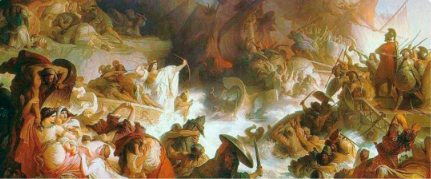
The exceptional case of Artemisia is that the man who refused her advice acknowledges her acumen and strength in battle by inadvertently renouncing the notion that men are superior to women, in an exclamation he utters after Artemisia rams her ship into what he supposes is one commandeered by the enemy as she is being pursued by a Greek ship : “My men have become women, and my women men.” Xerxes says (Herodotus, 8.88). He does not know that the ship Artemisia rammed into with the aim of losing her ship’s pursuer–the Athenian commander Aminias of Pallene–was that of one of Persia’s allies, the Calyndian king, Damasithymos. Knowing that Xerxes’s forces are losing the battle, Artemisia makes a spontaneous decision to save herself and the Carians in her command, tricking the Athenian commander who cannot see that she is a woman–and, thus, the queen who dared to wage war against Athens, the one on whose head the Athenians put a bounty--into believing that she is an ally of the Greeks or “a deserter from the Barbarians fighting for the Greeks” (Herodotus, 8.87, 8.93-94). Thus, the Athenian commander leaves her ship alone, and since Xerxes cannot see whose ship Artemisia just sent to the bottom of the Aegean from his golden throne on Mount Aigaleo overlooking the straits, he assumes that Artemisia has both eluded her pursuers and sunk an enemy vessel (Herodotus, 8.88). Thus, in one fell swoop, she deceives both men and succeeds in extricating herself, her crew, and her ship from the doomed battle.
We do not know why she chose to sink the ship of a king who was an ally of Persia, whether there was some sort of pre-existing hostility between Artemisia and Damasithymos which contributed to her decision to ram it or if the ship simply happened to be at the wrong place at the wrong time. It is clear that this act facilitated the salvation of herself and her crew from destruction, while at the same time earning her the admiration of Xerxes, who finally listened to her counsel and gave the order for his forces to retreat, though not before decisively losing the battle. Following this defeat, Xerxes holds a council to decide whether he should stay in Greece or return to Persia (Herodotus, 8.101). Artemisia advises him to return home, as he has already achieved his primary goal by burning Athens, adding that he can safely leave the rest of the campaign to his general, Mardonious. This time, once again acting in accordance with Artemisia’s counsel, Xerxes agrees to leave Greece, and–in an act that shows he trusts her good judgement–entrusts his sons to Artemisia, who takes them to safety in Ephesus on her voyage back to Halicarnassus (Heredotus, 8.101-103).
Once Artemisia successfully delivers Xerxes’ sons to Ephesus, once her heroic deeds are done and her wisdom and strength in warfare are recounted by Heredotus, who was her compatriot, about fifty years after the Battle of Salamis, we lose track of how Artemisia’s life unfolded at home. She completely disappears from the primary historical record. However, when we lack literary sources, we can always turn to material evidence. Ancient coins and monumental inscriptions, such as The Salmacis Inscription, show that by roughly 460 BCE–around 35 years before Herodotus finalized the Histories–her son Psindelis had succeeded her to the throne of Caria. This suggests that she most likely died of natural causes or peacefully stepped down to let her son rule as he came of age. Still, we do not know what happened in the years between her return from Salamis and her son’s ascension to the throne. Though there is always the possibility of finding even a fragment of her story in the ancient city of Halicarnassus, deep within the sparkling waters of Bodrum, or on stone inscriptions yet to be discovered, as archaeologists and scholars continue to search for the chapters in her life that are lost to history.
Perhaps this is what makes Artemisia’s story so compelling. She was a woman who commanded her own navy, revealed herself to be the wisest counselor of the Persian king’s council, and survived a battle that destroyed much of the fleet around her, yet when the courage and “manly spirit” she displayed at Artemisium and Salamis–surrounded by men who did not know who she truly was besides a warrior queen who proved how invaluable a woman could be in warfare–are recounted by the male historian, her story ends. Heredotus, for all his admiration of her because “she was a woman who fought in the war against Greece,” does not take the trouble to tell us who she was as a monarch and a mother, how her life unfolded after the thrill of the battle was over. Still, we are fortunate that Herodotus chose to preserve her deeds, although we cannot know how many other women whose voices were just as perceptive, whose lives were just as remarkable, were never granted the same chance to be remembered. Artemisia’s story, then, is not merely one of a woman who defied the expectations of her time, but also of how fragile history’s memory of women can be, and how much of their history may still lie beneath the ground, in a stone inscription or on a clay tablet, or beneath the vast seas and oceans with their secrets hidden in the depths, waiting to be uncovered.
Bibliography
Heredotus. The Histories. Translated by Aubrey de Selincourt. London: Penguin Books, 2003.
Garcia, Brittany. "Artemisia within Herodotus' Histories and 300: Rise of an Empire."
Sissa, Giula. "What Artemisia Knew: The Political Intelligence of Artemisia of Halicarnassus." In Identities, Ethnicities and Gender in Antiquity, edited by Jacqueline Febre-Serris, Alison Keith, and Florence Klein, 49-68. Berlin and Boston: De Gruyter, 2021.
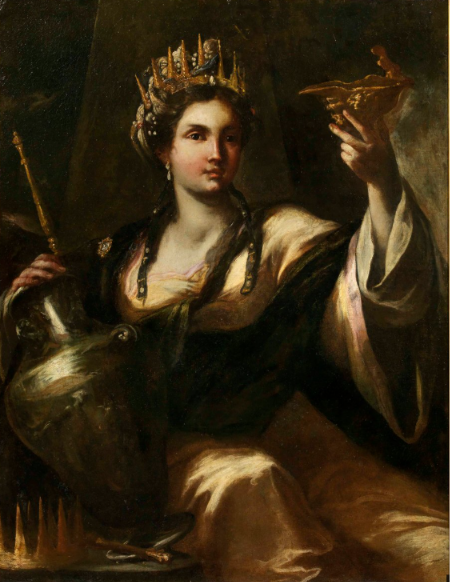
Artemisia by Giovanni Antonio Burruni
William von Kaulbach’s 1868 painting The Naval Battle at Salamis